


Lead-Bismuth Alloy
Lead-bismuth alloy is used for low-melting alloys and to produce pure bismuth and lead.
The pure metals that arise after refining lead-bismuth alloy are applied to different purposes. While lead is primarily used in the battery industry, bismuth serves as a compound in the pharmaceutical industry and as a catalyst in the chemical industry. Moreover, bismuth is used to product pigments, lacquers, and paints, as well as to manufacture thermoelectric appliances.
Both lead-bismuth and lead-antimony litharge from Aurubis fulfill the REACH requirements.
Main applications of bismuth
- Chemical industry
- Pharmaceutical industry
- Alloys
- Metallurgical additives
- Pigment industry
Specifications of lead-bismuth alloy |
|
| Bi | 6-12% |
| Ag | max. 100 g/dmt |
| Au | 0-10 g/dmt |
| Sb | max. 0.2 % |
| As | max. 0.05 % |
| Sn | max. 0.001 % |
| Cu | max. 0.05 % |
| Zn | max. 0.0005 % |
| Ni | max. 0.0006 % |
| Ca | max. 0.001 % |
| Mg | max. 0.01 % |
| TL | About 10 ppm other trace elements |
| Pb | Balance |
| Packaging unit | Ingots of 50 kg each |
Sustainability
Transparency through product data
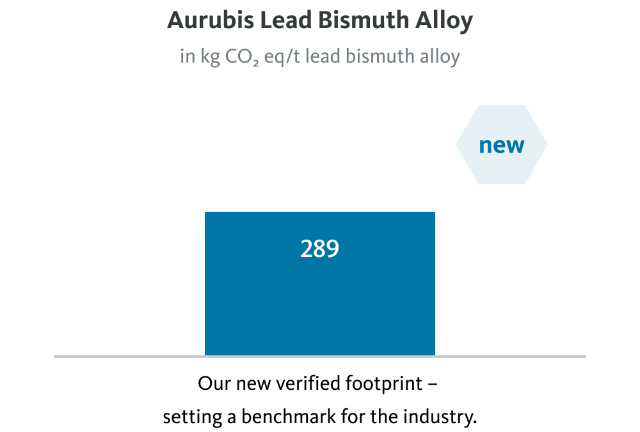
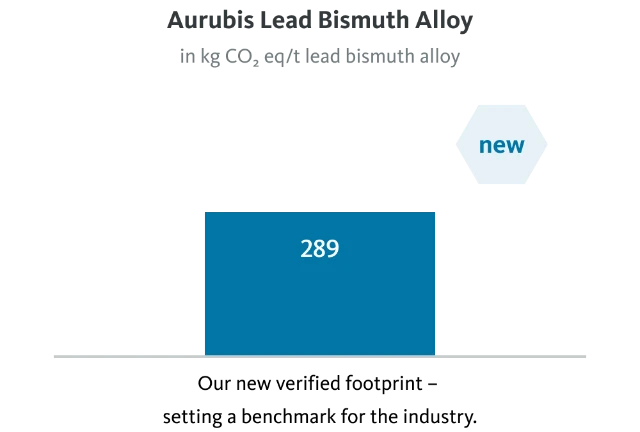
Metals are essential to the modern world, and transparency is key to reducing their environmental impact. For five years, Aurubis has published independently verified Environmental Footprint Declarations (EFDs), based on Life Cycle Assessment methodology and verified by TÜV NORD. In 2026, we now cover 14 product groups, pioneering transparency in our industry. Where comparable benchmarks exist, our products perform better. Where they don't, we are setting new standards for transparency. Because reliable data enables better decisions, measurable progress and more sustainable value chains. Our contribution to a net-zero future.



Tomorrow begins with what we shape today.
Ausgezeichnete Nachhaltigkeit: Unsere Zertifikate, Preise und Initiativen
Aurubis is setting new standards for sustainability in the metals and mining industry – third-party verified and internationally recognized.


